
Short answer
What is a transport management system?
A transport management system is the software a transport business uses instead of paper registers and spreadsheets to run its daily operations. It holds every booking, the transport document issued for it, the vehicle and driver that carried it, its delivery status and the money owed for it, in one place that the whole office can search.
The term covers two quite different kinds of product. Large manufacturers and retailers use a shipper TMS to plan shipments and choose carriers. Transport companies, fleet owners and booking agents, the businesses that actually move the goods, need a transporter TMS built around their own documents: in India that means the GR, LR or bilty. This guide is about the second kind.
How a TMS works: the life of one load
Follow a single consignment through a transport office and you see everything a TMS has to handle:
- Booking. The customer (consignor) books a load: goods, weight or number of packages, from and to city, and who will receive it (consignee). A TMS fills in a regular customer’s details automatically.
- GR / LR issued. The transporter issues a goods receipt (GR), also called a lorry receipt (LR) or bilty. The TMS gives it the next GR number, calculates freight from the rate, and prints copies for the driver, consignor and consignee.
- Dispatch. The vehicle number, driver details, invoice number and e-way bill number are recorded against the GR, so everything about the trip sits in one record.
- In transit and delivery. The load’s status moves from booked to in transit to delivered, so anyone in the office can answer “where is my maal?” without phoning the driver.
- Billing. Freight is collected on the spot (paid), at delivery (to pay) or billed later (to be billed). A TMS turns the GRs for a customer and period into a freight bill or statement.
- Payment and records. Payment status is marked when money arrives, and every GR stays searchable by number, party, vehicle or city for disputes, audits and repeat bookings.
Core features of a transport management system
These are the features that matter for a road transporter, in rough order of how often you will use them.
| Feature | What it does | Why it matters |
|---|---|---|
| GR / LR creation | Builds the consignment note with all parties, goods, route and charges | The document every load needs; replaces the carbon GR book |
| Automatic numbering | Gives each GR the next unique number | No duplicate or skipped numbers, no arguments later |
| Freight calculation | Rate × quantity per KM, box, kg, quintal or ton | Removes arithmetic mistakes on every GR |
| Customer master | Saves consignor details, GSTIN and default pricing | Regular customers are filled in with one click |
| Printing | Prints driver, consignor and consignee copies | Clean, readable copies with your letterhead |
| Status tracking | Booked, in transit, delivered | Answer customer calls without phoning drivers |
| Billing and statements | Freight bill for a customer and date range | Month-end billing in minutes, not days |
| Payment tracking | Paid or pending per GR | See who owes you money at a glance |
| Search and records | Find any GR by number, party, vehicle or city | Years of records, instantly |
| Import and export | Bring in Excel data; download full backups | Easy switch in, no lock-in out |
| Offline access | Keeps working without internet | Essential in yards and towns with weak connectivity |
Types of transport management systems
Shipper (enterprise) TMS
Built for manufacturers, retailers and 3PLs that send large volumes and hire many carriers. Focus: route and load planning, carrier selection, rate negotiation and freight audit. Usually priced as an enterprise contract with a long implementation.
Transporter TMS
Built for the transport company itself: fleet owners, transport agencies and booking offices. Focus: GR/LR creation, customer accounts, delivery status and freight billing. Quick to set up and learn. BiltyOne is a transporter TMS.
Transport ERP
An all-in-one suite that adds accounting, payroll, fleet maintenance, fuel, tyres and inventory to the TMS core. Suits larger fleets with in-house accounts and workshop teams. See transport ERP software vs TMS.
Fleet tracking (GPS) software
Shows where each vehicle is, using a GPS device or the driver’s phone. Useful, but it is not a TMS on its own: it knows where the truck is, not what it is carrying, for whom, or who owes you money for it.
Why Indian transporters need a TMS
Road transport in India runs on paperwork that a general business tool does not understand:
- The GR/LR is central. It is the transporter’s receipt for the goods and the contract of carriage, and under GST a goods transport agency is defined by issuing a consignment note. Every load needs one, usually in three copies.
- E-way bills reference it. For most goods worth more than ₹50,000, an e-way bill must accompany the movement, and its transport details include the transport document (GR/LR) number. Keeping both numbers on one record saves time at checkposts and audits. Official rules: ewaybillgst.gov.in.
- Billing types are specific. Paid, to pay and to be billed (TBB) each change who pays and when. Spreadsheets rarely handle these cleanly.
- Paper does not survive. Carbon copies fade, books get wet in the monsoon, and finding a GR from last year can take an afternoon.
- Staff cost adds up. Many offices pay someone mainly to write and file GRs. A TMS lets one person do the work of several.
TMS vs transport ERP vs Excel
| Paper book / Excel | Transporter TMS (e.g. BiltyOne) | Transport ERP | |
|---|---|---|---|
| Main job | Write and file GRs by hand | GRs, customers, status and freight billing | Operations plus accounts, HR, fleet and stock |
| Setup time | None | Hours to a day | Weeks to months |
| Training | None | About a day | Formal training for each module |
| GR numbers and freight | By hand | Automatic | Automatic |
| Customer bills | Typed separately | Built in | Built in |
| Accounting and payroll | Separate | Excel export to your accountant | Built in |
| Cost | Paper and staff time | Low or free | Licence, implementation and per-user fees |
| Best for | Very low volume | Small and mid-size transporters | Large fleets with in-house accounts |
How to choose a transport management system
Shortlist two or three options and check each one against this list, using your own GRs:
- Does it print a GR/LR that looks right to your customers and drivers, with your logo, GSTIN and address?
- Can you create a GR in under two minutes once a customer is saved?
- Does it calculate freight the way you charge: per KM, box, kg, quintal or ton?
- Can it produce a freight bill or statement for one customer over any date range?
- Can you import your existing customer list and old GRs from Excel?
- Can you export everything to Excel at any time, without asking the vendor?
- Does it keep working when the internet is down?
- Can your least technical staff member learn it in a day?
- Is the total cost clear: licence, setup, per-user and renewal fees?
Our longer checklist, with questions to ask vendors and a one-week trial plan, is in how to choose transport management software in India.
Where BiltyOne fits
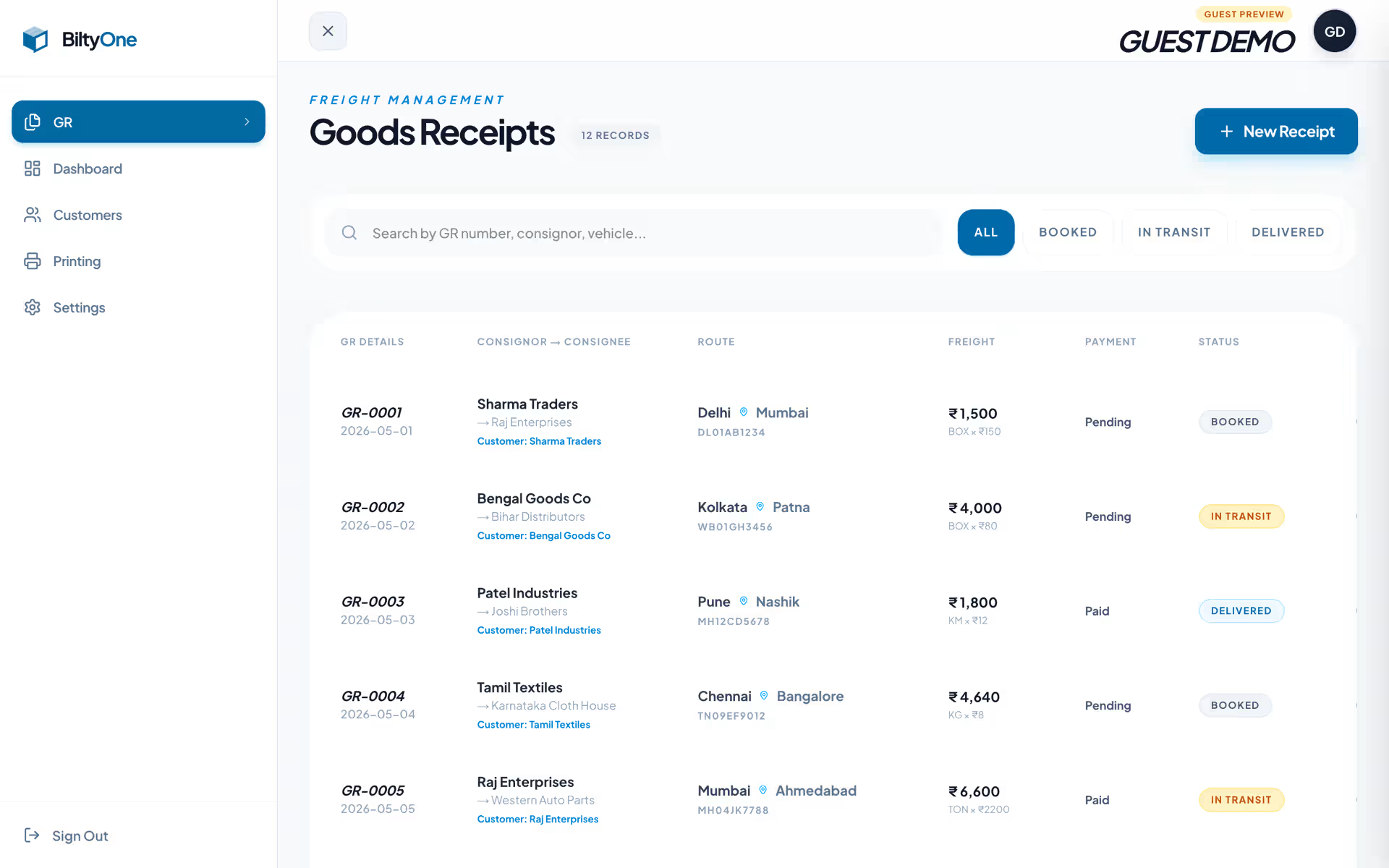
BiltyOne is a transporter TMS for Indian road transport. It covers the work every transport office does daily: GR/LR creation with automatic numbers and freight, three-copy printing with your branding, a customer directory, booking and payment status, customer freight statements, Excel import and backup, and an analytics dashboard. It runs online in any browser, and BiltyOne Desktop works offline on Windows.
It deliberately does not do GPS tracking, route planning or accounting. If you need those, run them alongside BiltyOne or choose a full ERP. For most transporters with up to about 50 trucks, the focused tool is faster to adopt and costs far less: BiltyOne is free for early transporters. See every capability on the features page.